Imagine a prospect Googles your company name plus the word "reviews," and the AI-generated answer at the top of the page says — confidently, in plain language — that your business "is known for dubious business practices and is often perceived as a scam."
That’s not a hypothetical. It’s exactly what happened to two Munich-based publishers, and it produced what’s believed to be the first court ruling anywhere holding an AI company liable for what its AI made up.
What actually happened
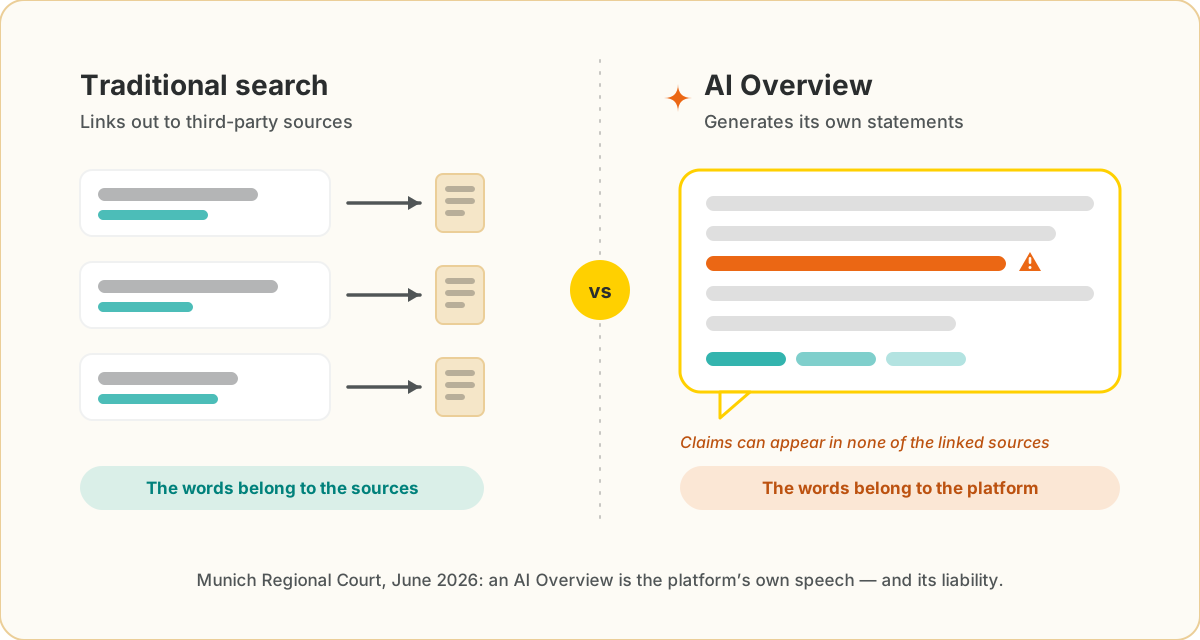
On May 28, 2026, the Regional Court of Munich (case 26 O 869/26) issued a temporary injunction against Google over false statements in AI Overviews — the AI-generated summaries that now sit above the traditional results on many Google searches (The Decoder, Ars Technica).
Two publishing companies discovered that AI Overviews was tying their names to scams, subscription traps, and shady business practices. The AI had apparently confused them with genuinely sketchy companies operating in the same space and stitched the bad reputation onto the wrong brands.
Three details should stop every business owner cold:
- The claims appeared in none of the cited sources. The court found the AI Overview "contains statements that do not appear in the search results at all." The AI didn’t summarize a bad review. It invented the accusation.
- Google didn’t fix it when asked. The publishers sent a cease-and-desist earlier this year. The false answers kept appearing.
- The court said AI answers are Google’s own speech. Not search results, not neutral links to third parties — Google’s words, with Google’s liability attached. The judges compared it to press law: a publisher is responsible for a headline that stands on its own, even if nobody reads the full article.
Google argued that users know to verify AI output against the linked sources. The court rejected that flatly — the ability to fact-check a false statement doesn’t excuse whoever published it — and added the line that made headlines: "nobody needs AI to search the internet."
One caveat worth stating honestly: this is a preliminary injunction from a German regional court, not a final judgment, and it sets no precedent in US courts. But it’s a directional signal, and the direction matters.
The part that should worry you isn’t the lawsuit
It’s how the publishers found out.
There was no notification. No alert. No dashboard. Two legitimate companies were being described as scams at the top of the world’s biggest search engine, to anyone who searched, for who knows how long — and the only way to know was to run the search yourself.
Here’s the uncomfortable question for any business doing $10M+ a year: when did you last check what ChatGPT, Gemini, Perplexity, or AI Overviews actually say when someone asks about your company?
Most leadership teams have never done it once. Yet your prospects are doing it daily. They’re asking AI assistants "is [your company] legit?", "who are the best [your category] firms in [your city]?", and "[your company] vs [your competitor]" — and they’re getting confident, fluent answers assembled by a system that, as Munich just demonstrated, will fabricate claims that exist in zero sources and attach them to the wrong company.
A bad Google review at position eight is a known problem with known playbooks. A false statement in an AI answer is worse in every way: it reads as a verdict rather than an opinion, it appears above every organic result, and the person it misleads never clicks through to anything you control.
AI answers are publishing — and that changes the playbook
The Munich court’s core finding — that an AI Overview is the platform’s own editorial product, not a list of links — is the quiet part said out loud. And it has practical consequences for how you manage your brand, whether or not the legal theory ever crosses the Atlantic.
Expect AI answers to get more conservative, and more citation-driven. If platforms bear liability for invented claims, the rational response is to lean harder on verifiable sources and hedge anything uncertain. That raises the value of being the clearly citable source of truth about your own business.
Your entity footprint is now a defensive asset. AI systems misattributed scam reports to the Munich publishers because the signals around those brands were ambiguous enough to confuse. The same conflation risk applies to you: a similar name in your industry, an inconsistent address across directories, an outdated service description on a profile you forgot exists. The cleaner and more consistent your facts are — across your site, your structured data, your directory listings, your LinkedIn page — the less raw material an AI has to get you wrong. This is the unglamorous core of what’s being called Generative Engine Optimization (GEO), and it overlaps almost entirely with search engine optimization (SEO) fundamentals: clarity, authority, structured data, consistent citations.
Monitoring AI answers is now basic reputational hygiene. In 2010, setting up Google Alerts for your brand name was table stakes. In 2026, the equivalent is periodically asking the major AI assistants the questions your prospects ask, and documenting what comes back. If something false appears, the Munich ruling also tells you the escalation path matters: the publishers’ cease-and-desist letter — and Google’s failure to act on it — was central to the court’s decision. Paper trails count.
Don’t bet your pipeline on a channel whose rules are being rewritten mid-game. AI search is already shaping buying decisions, and that won’t reverse — the judge’s quip aside, your buyers clearly are using AI to search. But the legal and technical ground under these platforms is moving. The durable strategy isn’t chasing placement in any one AI’s answers; it’s making your business the easiest, safest thing for any of them to describe accurately.
What to do this week
You don’t need a legal team or a new tool stack to act on this. You need an hour:
- Run the searches yourself. Ask ChatGPT, Gemini, and Perplexity: "What does [your company] do?", "Is [your company] reputable?", "Best [your category] in [your city]." Google your brand name plus "reviews" and read the AI Overview if one appears.
- Log what you find. Screenshot anything wrong, dated, or weirdly off. If an answer confuses you with another company, that’s your highest-priority fix.
- Audit your facts at the source. Does your own website state plainly what you do, who you serve, and where you operate? Is that consistent with your Google Business Profile, LinkedIn, and the directories you’re listed in? AI systems can only be as accurate as the trail you’ve left.
- Make it recurring. Put a quarterly reminder on the calendar. AI answers change constantly as models and indexes update — a clean read in June doesn’t guarantee a clean read in October.
The Munich publishers learned what AI was saying about them the hard way, after the damage was circulating. The smarter position is knowing before your prospects do — and if you’d rather get a structured read on how visible and accurately represented your business is across AI search, that’s exactly what our no-cost AI Search Visibility Benchmark was built to show you.